Sunday, October 27, 2013

October 2013 Edition #14: THE CONJURING


Director: James Wan
Screenplay: Chad & Carey Hayes
Starring: Patrick Wilson, Vera Farmiga, Ron Livingston, Lili Taylor
Release Date: July 19th, 2013


THE CONJURING is an absolutely hair-raising tale of parapsychological terror, a fantastic throwback to classic ghost stories such as THE HAUNTING and THE AMITYVILLE HORROR that allow character and atmosphere to take center stage over special effects, creating an unbearable tension and fear of the unknown that, once unleashed, creates the sensation of free-falling into the mouth of hell itself. Director James Wan has taken the lessons learned on his previous horror outings, including SAW and INSIDIOUS, to craft a remarkably well-made and thoroughly chilling tale that will make even the most ardent non-believers in the supernatural think twice about venturing into the darkened corridors of their homes in the middle of the night.


The film follows two families, the Warrens and the Perrons. Ed (Wilson) and Lorraine (Farmiga) Warren are paranormal investigators living with their daughter in New England whose services are called upon by Roger (Livingston) and Andrea (Taylor) Perron. After moving into an old farmhouse in the backwoods of Rhode Island with their five young daughters, the Perrons have been subjected to a series of bizarre and increasingly malevolent occurrences. After the accidental discovery of a basement hidden behind the wall of a downstairs closet the family begins to notice small peculiarities around the house. Pictures are knocked off of the wall, every clock in the house stops at 3:07 every morning, strange knocking sounds can be heard coming in repetitions of three, and the smell of death seeps into the oldest girls’ bedroom every night. The youngest girl’s beloved dog mysteriously dies, birds kill themselves by smashing into the upstairs window, and Andrea wakes up each morning with unexplainable bruises all over her body. Soon the malignant entity perpetrating these becomes outwardly violent, taunting the girls as they lay terrified in their beds, and luring Andrea into the basement  by emulating the sound her daughter’s hand-clapping while playing Marco Polo. As the toll on her family becomes unbearable, Andrea turns with desperation to the Warrens, who once visiting the house immediately sense the vile entity and it’s nefarious deeds. Over the course of the next several nights the duo bring in their investigative crew, angering the demon and leading to a series of events that threatens to devour the very souls of both families.


THE CONJURING claims to be based on true events, chronicling a heretofore undisguised encounter the Warren’s experienced in the early 1970’s. This of course is complete horseshit, as was the couple’s chronicling of the events in Amityville, Long Island. However I’d rather not get into the argument over the questionable morality of the Warren’s real-life adventures, if, as their critics so passionately dispute, they weren’t in fact merely exploiting people suffering from severe mental illnesses for personal gain. That’s not the point of this movie, and also I haven’t done the research on the subject and wouldn’t know what the hell I was talking about anyway. What matters is that THE CONJURING, while trading in the sort of haunted house tropes seen every week on awful shows like PARANORMAL WITNESS, takes the material and elevates it via enveloping sound design, a truly hellacious score, and some electrifying yet subtle camerawork that successfully places the viewer in the mindset of the Perrons to truly chilling effect.


James Wan has demonstrated in the past a clear understanding of what makes the best horror films work. While his break-out hit SAW has become notorious for the torture-obsessed films it inspired, Wan has gone on to exude a level of restraint in all of his films that followed, allowing the characters to drive the narrative forward while subtly messing with the viewer’s mind behind the camera. The most effective scene in THE CONJURING for me involves one of the young girl’s being awakened by something tugging on her leg in the middle of the night and cautiously hanging her head off of the side the bed in order to see what might have done it. The camera goes upside down with her, immediately putting the viewer in her headspace, as I’m sure just about everybody can remember doing the same thing as a child. Wan milks this scene for every bit of tension he can, focusing on the child’s increasingly horrified expression as she stares into the darkness beside her bedroom door at…nothing. At least as far as the audience can see. As she jolts up to see what it could be, the camera flips over and upwards with her, keeping the viewer off balance and in tune with the character’s growing alarm. Wan uses his roving camera and subtle use of CG to enhance the dreadful eeriness of the most seemingly mundane objects and scenarios, as when the Warren’s daughter becomes trapped by the entity in a magnificently foreboding hallway at night, the simple clapping of hands out of the darkness, or in one brilliant moment a single strand of hair on a characters head seeming to raise up due to static electricity…..or, as it quickly turns out, something far wors
e.


Of course none of this would matter if the characters weren’t worth a damn, but fortunately all involved bring their A game. I’ve enjoyed the work of Ron Livingston, who brings a working class familiarity to all of his characters, making it easy to empathize with the plight of he and his family. Lili Taylor more than makes up for her role in the abominable THE HAUNTING remake as Andre and, despite the fact that they are portraying people who were, for all intents and purposes, charlatans, Patrick Wilson and Vera Farmiga acquit themselves nicely, portraying the Warren’s as a selfless duo who want nothing more than to help this family rid itself of this demonic vermin.


The flick, in my opinion,  isn’t nearly as scary as INSIDIOUS, due mostly to the fact that the film’s “true story” claims basically eradicates any tension I might have felt as to the character’s fates otherwise. While the film is filled with eerie, downright disturbing scenarios and copious expertly-timed jump scares, I never had a sense that any of the characters were in any real danger, thus lessening my emotional involvement. Contrast that with INSIDIOUS which, though treading the borders of ludicrousness in it’s third act, was absolutely unpredictable and therefore, to me at least, far scarier.


With THE CONJURING James Wan has announced himself, in my eyes, as the heir to the throne of modern horror master, combining the insane camerawork of Sam Raimi with the relative restraint of John Carpenter to produce a fantastic melding of old and new-school techniques. Hell, even the opening credits, with it’s introduction to what we are about to see and it’s 70’s style yellow text, is mortifying. Despite some minor quibbles with the basic story, as well as the film’s somewhat infuriating claims that the persecuted women of Salem, Massachusetts actually worshipped Satan, the flick works as an exceptional ride, an adrenaline-fueled nightmare that perfectly exploits universal fears. It is not a masterpiece, but it is the goddamned scariest thing I’ve seen since INSIDIOUS. And keep in mind, nothing scares me anymore, so that’s saying a lot.

My Rating:
8.5/10


Friday, October 25, 2013

October 2013 Edition #13: ISLE OF THE DEAD


Director: Mark Robson
Screenplay: Ardel Wray, Val Lewton (uncredited), and Josef Mischel (uncredited)
Starring: Boris Karloff, Marc Cramer, Jason Robards, Ellen Drew, Katherine Emery, Helene Thimig
Release Date: September 1st, 1945


From 1942 to 1946 film producer Val Lewton was tasked with heading up the horror branch of RKO pictures. His assignment was to produce features for less than $150,000 with a running time of no more than 75 minutes, based on nothing more than a lurid title provided by his supervisors. Working within these constraints Lewton gathered a group of directors together and churned out a series of films that relied entirely on atmosphere and the restless imaginations of the viewer to invoke their scares. Lurid titles like Jacques Tourneur’s CAT PEOPLE and I WALKED WITH A ZOMBIE have been lauded by filmmakers as renowned as Martin Scorsese for their ability to invoke dreadful frights out of thin air. Until now, I hadn’t seen any of the films Lewton produced, but after giving ISLE OF THE DEAD a shot, I am very eager to check out the rest of his oeuvre.


The film is set in Greece during the First Balkan War, and follows General Pherides (Karloff) known among his men as “The Watchdog” due to his harsh methods, such as forcing one of his colleagues to commit suicide for underperforming in a recent battle. Marc Cramer co-stars as Oliver Davis, an American war correspondent who agrees to accompany Pherides to a nearby island, know as the “Isle of the Dead”, to visit the tomb of Pherides deceased wife. Once there, they discover the tomb empty, but follow the haunting singing of a female voice to the home of Dr. Albrecht, an archaeologist who lives on the island with his maid, Madame Kyra, along with several houseguests. When one of the guests dies in their sleep, it is determined that a plague has beset the isle, and General Pherides, fearful of infecting his troops, issues a strict quarantine. No one is to leave the island until he deems it safe. But the superstitious Madame Kyra is convinced that they are actually being preyed upon by a Vorvolaka, a sort of vampiric female demon, and as the body count rises the increasingly psychotic Pherides begins to agree, fingering the innocent Thea as his prime suspect. With all exits and, seemingly, their fates sealed, the rest of the group attempts to maintain their sanity as well as their humanity until the plague passes.


What makes this flick work is, absolutely and without a doubt, the immense dread-filled atmosphere that drenches every frame from beginning to end. The entire movie seems to take place in a perpetual dusk, and the early scenes as Pherides and Davis traverse a ravaged battlefield takes full advantage of the artificiality of the stage-bound surroundings, with the inky blacks and sharp contrast lending the scenes a very noir-ish quality that effectively sets an eerie mood. Once the pair arrive on the isle the dread is omnipresent. It certainly helps that much of the film involves our characters ruminate on their mortality, coming to terms with the fact that they could certainly die in the ensuing hours. One of the guests, Mary, suffers from catalepsy, a condition in which the sufferer falls into a deep coma lasting up to a day in which they appear to be dead. She is utterly petrified of accidentally being buried alive and, through a rather large plot contrivance, only shares this information with Dr. Drosso, who conveniently succumbs to the plague before he can warn anybody. As the power struggle between Pherides and the rest of the guests plays out, Mary acts as the proverbial ticking time bomb. We know exactly what’s going to happen, but when, and how will it play out?


Most of the acting is rather off-putting, as Davis and the rest seem far too at ease with what’s occurring, mostly treating the whole thing as a lark. Karloff really carries the show here, bringing an intensity to Pherides that imbues the flick with a real sense of tension. Easily influenced by the malignant Kyra after finding his wife’s corpse missing, it is clear that Pherides is only doing what his training tells him is the right thing to do, even if that entails the murder of a clearly innocent girl.


What’s cool about this movie is that, despite the reliance on the legend of the Vorvolaka, there is absolutely no supernatural presence involved in this tale. The only corpse that rises from the grave is that of Mary and, while I realize that might sound spoilery, the movie makes no bones about trying to hide her eventual fate. What is awesome is how the scene of her awakening plays out, via a series of shots cutting back to the darkened crypt in which the remaining guests have entombed the still-living woman. With each cut the camera comes closer to the tomb, focusing in on water droplets landing on the lid, each splash louder than the last until…..I won’t give it away, except to say that I was utterly taken aback by just how effectively chilled I was by a movie that is nearly seventy years old.


Though relatively light in plot and certainly slow-moving by modern standards, at a lean 72 minutes there is little room for complaint with regards to the film’s methodical pacing. Director Mark Robson set out to tell a story of a man letting his imagination get the best of him, effectively frightening himself to death, and in doing so puts the viewer through the same experience. ISLE OF THE DEAD may be old-fashioned, but scary is scary, folks, especially when the terror comes from within one’s own mind.

My Rating:
8/10

Wednesday, October 23, 2013

October 2013 Edition #12: C.H.U.D. II: BUD THE CHUD


Director: David K. Irving
Screenplay: M. Kane Jeeves
Starring: Brian Robbins, Bill Calvert, Tricia Leigh Fisher, Gerrit Graham, Robert Vaughn
Release Date: September 27th, 1989 (VHS)


Aw fuck, man, do I really have to review this movie for you guys? I don’t want to. I really don’t. I’ve put off writing this thing for over two weeks, because I knew I’d eventually have to think of…..something…..anything to say about C.H.U.D. II: BUD THE CHUD. I don’t want to. I can’t. I refuse. This movie is bad, and wrong, and you are bad and wrong for expecting me to relive what I witnessed on that bargain-basement DVD. But if I have to, I’m going to make this short and sweet.


Alright, so here’s the deal. It’s been a long damn time since I’ve seen C.H.U.D. A really long goddamn time. While the flick is ultimately rather silly and cheap, that was not the goal the filmmaker’s set out to achieve, and so the flick sorta works despite itself. It’s tale of homelesss itinerants being transformed into sewer-dwelling hellbeasts by toxic waste made for a decent, if intensely stupid eco-horror film. C.H.U.D. II: BUD THE CHUD, on the other hand, is just the worst kind of a movie, a derivative knock off, an asinine piece of garbage that trades off of the recognizability of the original’s title in order to simultaneously rip off both one of the best and one of the worst horror comedies of the 1980’s.


The plot follows a cadaver, the last of the C.H.U.D.’S, code-named Bud (Graham) by the U.S. military. They’ve decided to shut down the C.H.U.D. program and have frozen his body and shipped it off to, and I quote, “a government research facility in some podunk town.” In that podunk town two hight schoolers, Steve (Robbins) and Kevin (Calvert) accidentally lose the corpse intended for dissection in their biology class (don’t get me started), and decide to sneak into the nearby military base to steal a corpse to replace it. They steal Bud, accidentally reanimate him via electrocution, and non-stop retardity ensues.


Despite the title’s claim, Bud is not a C.H.U.D. He’s a fucking zombie, and his name is partially stolen from Bub the zombie from George Romero’s DAY OF THE DEAD. The first act of this movie, with the kids stealing the corpse from the secret lab, is a direct lift from NIGHT OF THE CREEPS, and the ensuing small-town zombie invasion plays out almost identically to RETURN OF THE LIVING DEAD PART II, a movie that nobody over the age of 12 years old actually likes. C.H.U.D. II: BUD THE CHUD  is a zombie movie pretending to be a sequel to C.H.U.D. because the producer’s didn’t want to get sued for ripping off a more popular franchise. Bud walks around the town while a horrible “Bud The CHUD” theme song plays and, instead of crying for “Brains!”, goes around screaming “Meat!”. He bites a bunch of people, turning them into C.H.U.D.’s, and Steve and Kevin team up with their girlfriend to try to stop the zombie plague while Colonel Masters (Vaughn) tries to track down the monster and clean up the mess himself, eventually leading to a climax in which the zombies…I’m sorry I mean C.H.U.D.’s are defeated via electricity, just like in RETURN OF THE LIVING DEAD PART II.


I have no idea what the fuck Robert Vaughn is doing in this movie, and neither, I suspect, does he. He merely walks around in military attire, randomly flails around a cane, and improvises all of his lines….badly. So very  badly. The humor in this flick is what really kills it. “This C.H.U.D.’s for you!” is literally the cleverest line in the flick. Fuck you and your grandchildren if you think that shit is funny! In my opinion, there is nothing in this world worse than a failed comedy,  and C.H.U.D. II is one of the biggest failures I’ve ever seen. Of all the films to rip off, why RETURN OF THE LIVING DEAD PART II? This flick manages to somehow be lamer than that one, and that is no mean feat.


The acting is just fucking…..look, Gerrit Graham is the star of this flick, which is all you really need to know. It’s bad, the music is bad, the make-up effects are terrible, the gore is non-existent, the humor is terrible,  and did I mention they rip-off one of the worst sequels ever? Fuck! The only redeemable part of this flick is the random half-second cameo from Robert Englund, and that only managed to make me mad that his name was sullied by being linked with this piece of garbage.


Really, though! What are you doing here, Mr. Englund?!

I’ve wasted more time writing about this flick than is warranted. It is far from the worst movie I’ve ever seen, but goddamn…..I really struggled to get through this. It’s not even bad in an entertaining way, and I actively hated everybody involved for participating in this. Do yourself a favor. Watch C.H.U.D. instead. Watch RETURN OF THE LIVING DEAD. Hell, watch RETURN OF THE LIVING DEAD PART II, if you must. It sucks truck-loads of dicks, but at least it’s sorta funny. C.H.U.D. II: BUD THE CHUD is an embarrassment. I don’t want to talk about it anymore. Leave me alone.


My Rating:
1.5/10


Monday, October 21, 2013

October 2013 Edition #11: WORLD WAR Z


Director: Marc Forster
Screenplay: Matthew Michael Carnahan, Drew Goddard & Damon Lindelof, based on the novel by Max Brooks
Starring: Brad Pitt, Mireille Enos, James Badge Dale, Daniella Kertesz, Fana Mokoena
Release Date: June 21st, 2013


I should preface this review by acknowledging that I did not want to like this movie from the outset. Max Brooks’ novel WORLD WAR Z, on which this film purports to be based, was a seminal book for me. I read it shortly after it’s release in 2006, with the disaster of Hurricane Katrina and the subsequent mass panic during the evacuation for Hurricane Rita still fresh in my memory. That brief, terrifying period at the close of summer 2005 opened many people’s eyes, myself included, to the fragility of our society and how, due to government incompetence and the power of pure primal terror, everything could fall to pieces in an instant. Presented as a series of accounts from survivors of a ten year zombie war, Brooks’ novel presented just such a scenario, in which the center doesn’t hold. The zombies could have easily been replaced with any natural disaster, or plague, or act of terrorism. What resonated with me in the book was the way in which governments and their people could so viciously turn on one another in order to ensure their survival, and the individual moments of personal sacrifice to ensure one more day of life in a world gone totally to hell. Brooks’ novel acts as a twisted mirror image of what could easily happen to our world in a heartbeat, and as a result scared me in a more lasting way than perhaps any other piece of fiction I’ve encountered.


So when I first heard that Brad Pitt’s production company had purchased the rights to turn the novel into a film, I knew that it was too good to be true. As excited as I was by the prospect of finally seeing a full-scale zombie apocalypse being given the epic treatment and respect I had longed to see ever since my first viewing of Romero’s NIGHT OF THE LIVING DEAD all those years ago, I knew there was no way that could happen without some sort of compromise. And as the reports of constant script revisions, massive reshoots, and a mandatory PG-13 rating swirled around the media in the year leading up to release, I pretty much lost any excitement I had for the property. This looked to be a homogenized, family friendly blockbuster version of  decidedly non-family friendly material.


But after the initial disappointment subsided, I had a change of heart. I’m not here, after all, to review the film’s budget or production difficulties, or the fact that it should have an entirely different title. As a film that features Brad Pitt fighting zombies, albeit one that is unfortunately named after one of my favorite books, how does it stand up?

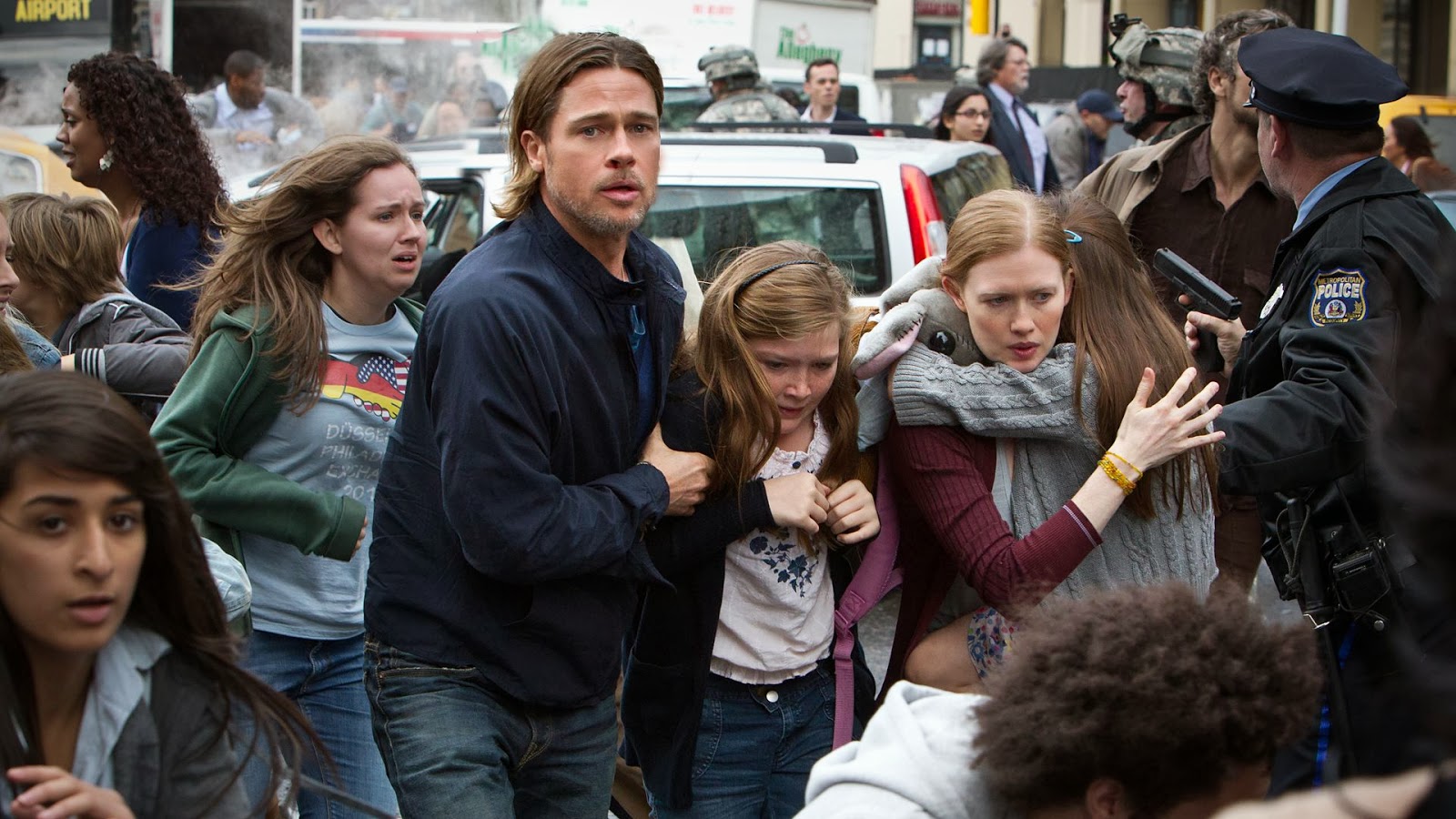
Pitt stars as Gerry Lane, a former UN investigator struggling to ensure the survival of his wife (Enos) and two young daughters after witnessing an epidemic of mass-murder as hordes of people who appear to be infected with a rabies-like virus overtake the city of Philadelphia in a matter of hours. After spending one terror-filled night in an apartment complex overrun with the infected, Gerry is able to secure a helicopter rescue for his family with the help of his old friend, UN Deputy Secretary-General Umotoni (Mokoena). The chopper takes the family to a Navy vessel in the Atlantic where scientists and military personnel are scrambling to ascertain the nature and origin of this bizarre virus. The last communications from a military base in South Korea confirm the unbelievable reality of the situation with the utterance of one word: zombie. Once it becomes clear that his family will be removed from the ship without his compliance, Gerry reluctantly agrees to go back to work, embarking on a globe-hopping journey to South Korea, Jerusalem and beyond in a desperate attempt to trace the origin of this plague and find a cure before all of mankind is consumed by the hordes of hungry undead.


What I’ve just described has absolutely nothing to do with Max Brooks’ novel, save for the general idea of tracing the zombie virus back to it’s origin and scenario of the naval vessel  harboring the last vestiges of the government in the middle of the Atlantic. But again, once I was able to get over the fact that this movie was NOT going to be the book, I was able to focus on the details that director Marc Forster and company were able to get right, and came away from the film mildly surprised. The first thirty minutes of the film, for me, are the absolute highlight, as Forster stages an action scene in downtown Philadelphia that perfectly captures the chaos and stark terror of the beginnings of a zombie outbreak that I’ve always longed to see. The fact that the film begins with the devastation of Philadelphia, which was once the headquarters for George Romero as he shot both NIGHT OF THE LIVING DEAD and DAWN OF THE DEAD, at the very least implies a certain level of respect from the filmmakers for the mythos that they are taking full advantage of. The mass hysteria and devastation on display in this segment was only hinted at via brief news reports in Romero’s films, allowing the viewer’s imagination to run wild and, though not nearly as horrific or epic in scope as I had envisioned, these scenes are mighty impressive. In fact, I was so thoroughly engaged in that first half hour that I completely forgot to take notes, so that’s gotta count for something. In fact, the one aspect that irked me the most from all of the trailers, that being the focus on Gerry’s struggle to keep his family alive, turned out to not be that bothersome, and even lead to some particularly intense scenarios, in particular a creepy sequence in which they attempt to navigate the darkened stairwell of the apartments as it is overrun by zombies. I was also thoroughly surprised by the amount of bloodshed present. While we never get to see any severe wounds or intestinal spillage, when the undead attack there is a respectable amount of blood spatter present, contrary to the reports I heard of absolutely no blood being present in the PG-13 rated theatrical cut. The version I viewed was unrated and, while fairly conservative when compared to, well, pretty much any zombie movie ever, I was pleasantly surprised to find enough severed limbs and at least one gushing geyser of plasma to keep my bloodlust satiated. I’m not one of these people who demands gore for gore’s sake, but in the context of the situations presented in this film the lack of any bloodshed would have seriously limited the film’s believability.


Once the group makes it to the aircraft carrier the flick settles down into your standard-issue procedural, as Gerry travels the globe searching for answers. It is here that the film comes the closest to following the through line of the novel, as Gerry collects the accounts of various survivors, including an ex-CIA operative imprisoned (an incredibly creepy David Morse)  at a U.S. military base in South Korea,  who claims that Israel having mysteriously received prior knowledge of the outbreak, has pre-emotively built a wall around the city of Jerusalem. This then leads into the next major action sequence, and one of my personal pet peeves with the flick, as it just seems far to convenient for Gerry to arrive in Jerusalem mere minutes before the zombies manage to amass into large enough piles to overtake the wall and storm the city. It’s these kinds of predictable tropes, more than likely studio-mandated, that rob the film of any realism. Sure, it’s a fun sequence, and the image of the zombie horde piling atop each other like fire ants is definitely alarming, but it does a great disservice. I can buy the idea of Gerry managing to survive thanks entirely to the dumb luck of his prior employment with the UN. I could even buy all of these crazy scenarios, including a later scene in which he sets off a grenade on an airplane mid-flight, if each happened to a different person, as in the novel. I cannot, however, swallow that this guy manages to survive all of this insanity, oh, and also manages to find a way to camouflage humans from zombies via the injection of normally deadly pathogens thus saving all of mankind from extinction. But, these are the minor quibbles, especially when one takes into consideration the idiotic tropes grafted onto most big studio tent poles. My biggest beef with this ending is that it completely misses the point of the novel, in which mankind is forced to band together and eradicate the zombie hordes house by house, street by street, city by city, and instead places all of that responsibility on one guy, who just happens to save everybody.


My problems with the  resolution aside, I did enjoy how, despite the grand scale  and carnage of the first two acts, the film ultimately winds down into a tense, Romero-esque siege, as Gerry and several scientists must quietly navigate a zombie-infested laboratory in order to get to the pathogen vault located on the other side of the facility. It is an intense, lengthy sequence, filled with some actual honest-to-God zombies made up with prosthetics, as opposed to the largely computer generated undead that populate the majority of the flick. Unlike the pixilated embarrassments presented in I AM LEGEND, these creatures are actually fairly well-realized and, in several instances, genuinely horrifying, so kudos to Forster and the effects team for leaving a bit of old-school movie magic in the mix.


I know I’m sounding lukewarm in my review, but that’s because WORLD WAR Z is a complicated movie not just for myself, but for the hordes of horror fans hungry to see Max Brooks’ vision of a world gone to hell properly realized. What we got is a compromised version that is about as good as one could ask for given the current studio environment. One would think that, given the massive popularity of THE WALKING DEAD, Paramount would not have shied away from telling this story with the gruesome gust it cries out for. But, I can’t deny the unfortunate economics of the situation. R rated movies have historically only made so much money, and to spend $200 million dollars on an ultra-violent Romero-styled splatter epic, while probably the most awesome thing to ever happen, would have been complete folly. This ultimately begs the question, then why even make the movie? I can’t answer that question, but the fact is they did, and while not exactly what I wanted, it really is not bad at all. If, like myself, you are a fan of the novel, you’ll have to meet this movie halfway. If you are willing to sacrifice any preconceived notions of what it ought to be, you can really have a good time with this flick. WORLD WAR Z, while somewhat predictable in it’s attempt to attract a mainstream audience, is ultimately a damn decent apocalyptic tale that, while never living up to it’s true potential, offers enough thrills and colossal mayhem to satisfy that part of every zombie fans’ mind that just wants to watch the world burn.

My Rating:
7/10

Concept art for "The Battle of Yonkers", the US Army's last stand against the zombie horde and, in my opinion, one of the most horrifying things I've ever read. Had it been filmed, it could have been one of the most viscerally devastating sequences in horror history. Alas.....


Saturday, October 19, 2013

October 2013 Edition #10: THE UNSEEN


Director: Danny Steinmann
Screenplay: Michael L. Grace
Starring: Barbara Bach, Sydney Lassick, Karen Lamm, Lelia Godoni, Stephen Furst
Release Date: September 1981


In the rush of horror films released to theaters during the early 1980’s, it was perhaps inevitable that a number of these movies would fall through the cracks of obscurity, remaining relatively unknown to all but the most devout genre completists over three decades later. While the disappearance of many of these films can be blamed on their general awfulness, a disturbing number languish in obscurity due to poor distribution and bickering between shady rights holders and the filmmakers. THE UNSEEN is one such film that, from it’s very inception, was never given the chance to achieve it’s true potential.


After a troubled shoot, the film was essentially taken away from director Danny Steinmann (who had his name removed from all prints of the film) during post-production and cut together by the producers. THE UNSEEN was barely released to a few theaters in 1981 and just sort of disappeared after that. I actually saw it broadcast on my local Fox affiliate one Saturday afternoon in the mid-90’s, but for the next decade and a half could not remember the title to save my life. It wasn’t until hearing an interview with Steinmann on a podcast several years back that I finally figured out the title, but I never did anything with the information. Cut to a month ago, when my local Alamo Drafthouse held a marathon of several of the FRIDAY THE 13th films, including the Steinmann-directed PART V: A NEW BEGININNG. That particular screening provided the best possible atmosphere I’ve ever viewed that film in, working the crowd like gangbusters with it’s utter shamelessness, beyond crude humor and excessively trashy (even by FRIDAY standards) sensibility.  After the screening I was suddenly seized by an uncontrollable urge to seek out more of Steinmann’s work which finally brings me, all these years later, back to THE UNSEEN. While I have seen this film before, I feel that it fits the theme of my blog as, due to the passage of time, I’m now seeing this flick with new eyes. Which is nice and all, but how does the flick hold up?


After a mix-up at their hotel leaves them without a place to stay, news anchor Jennifer (Bach) and her two friends Karen (Lamm) and Vicki (Lois Young) accept an offer from the seemingly benevolent museum owner Ernest Keller (Lassick) for room and board at the farmhouse he shares with his companion Virginia (Goldoni, who spends this entire flick on the verge of tears much as she did in INVASION OF THE BODY SNATCHERS). What they don’t know, unfortunately, might kill them, as Ernest and Virginia both share a mutual secret, a horror that lurks in the basement and creeps through the crawlspaces. As the night wears on, one by one the girls are stalked and killed by an assailant unable to stop itself, unmoved by their screams, a creature both unreal and…..(wait for it!)…..UNSEEN.


So, here’s the part where I spoil this movie, which I sorta need to do in order best sum up my feelings. First of all, former Bond girl Barbara Bach isn’t entirely terrible in the role of Jennifer, but lacks any real charisma, which is a major problem considering we’re supposed to be cheering for her survival throughout the film’s entire third act. In fact for much of the film’s first two-thirds it seems like she is acting in an entirely different movie. The early scenes of the film follow her and her friends as they look for a place to stay, and it is here that Steinmann (or his producers, at least) lay the groundwork for the film’s weakest aspect, a subplot involving Jennifer’s ex-boyfriend, Tony (Douglas Barr), following her to the festival to try and patch things up. With her friends back at the farmhouse, Jennifer and Tony go out for dinner, and then a long walk through a park, talking about their relationship issues, Tony’s refusal to give up on his football career due to a bum knee, and an abortion Jennifer apparently had behind Tony’s back. I only linger on this because this entire sequence is cut up and stretched out through the film’s mid-section, boring the audience to death and bogging down any story progression while simultaneously interrupting the “good stuff”.


And there is good stuff, to be sure, but only enough to frustrate at just how creepy this flick COULD have been. For starter’s, the film’s score by Michael J. Lewis is a nice, understated and eerie piece that sets the tone from the first frame of the opening credits and manages to keep things interesting in even the slowest scenes. Cinematographer Roberto A. Quezada’s isn’t quite up to the same level as the composer. His casually wandering camera explores every dusty nook of Ernest Keller’s family museum and moldy corner of his basement, effectively evoking the horror in even the most mundane, seemingly harmless locales. The scene in which a girl gets dragged screaming through a small grate in the floor of her bedroom by “The Unseen” is particularly upsetting. But large chunks of the film, in particular the opening scenes and Jennifer and Tony’s extended date, look like a cheap made for TV movie. The film still manages to pull of an immensely creepy vibe thanks to several stand-out performances, in particular Sydney Lassick as Ernest Keller. Though initially kindly and overly hospitable with a highly effeminate demeanor, once the girls get back to his farmhouse  Keller quickly begins to shed his skin and reveal the truly perverse monster hidden within. His relationship with Virginia is a very strained, emotionally abusive one. Lassick makes numerous strange choices, throwing random hissy fits and at one point putting clothespins on his face and taunting Virginia as though she were a child. On first view this behavior is pretty confounding, but once the film reveals the true nature of their relationship it makes a whole lot more disturbing sense.


Ernest and Virginia’s backstory is handled in the most clumsily expository manner possible, in a ridiculous scene in which Ernest has an inner monologue with his dead father, reliving the moment he killed the man after he was caught having sex with Virginia, who it turns out is his sister. To maker things even ickier, Virginia gave birth to a child, named Junior, whom Ernest has kept hidden away in the basement of their home.


It is here, in the final reveal of Junior, “The Unseen”, that the film ultimately drops the ball. Desperate to cover up the accidental deaths of Jennifer’s companions, Ernest lures her into the basement and locks her in with his son. What should be an incredibly tense finale is completely undermined  Junior (ANIMAL HOUSE’s Stephen Furst) finally appears, an overweight mentally retarded full-grown man with massive facial deformities clad in a giant diaper. Now, on the one hand, I have to admire Furst’s bravery in taking on this role. He has to really dig deep and go to some places I have rarely seen an actor attempt before. But it’s just too goddamned much. For the next ten minutes Junior childishly laughs and makes faces and paws at an obviously overwhelmed Barbara Bach, clearly wondering how in the hell she went from starring opposite Roger Moore to being mud-caked in a basement with a giant man-baby. I hate to crib someone else’s bit, but it definitely applies here. I have never seen anybody go more fully retarded than Stephen Furst does in this flick. It is just…..jaw-dropping.


That being said, I suppose the real point of the film is that Ernest is the true monster of the film, which is how things play out in the final confrontation, as he attempts to murder his family after they turn against him. It all leads to a chase scene with him and Jennifer in a torrential downpour, and Tony gets involved at the last second, though the resolution of his character’s arc is actually pretty fucking hilarious, if only for underlining how utterly pointless he was to the entire plot of the film.


This flick has been tough for me to review. Steinmann and co. were certainly ambitious in their attempts to up the creep factor of what is a fairly uninspired story. Despite claiming full credit for the screenplay, I believe Steinmann is selling short one of the many credited co-writers, Kim Henkel, as the strangely comedic dysfunction of the Keller’s shadows the cannibalistic clan from the superior TEXAS CHAINSAW MASSACRE, which Henkel co-wrote with Tobe Hooper. It seems like there were far too many cooks in the kitchen for this project, resulting in a film that somehow manages to try too hard and not hard enough. It’s not nearly as sleazy as Steinmann’s other work, a quality that really could have pushed this flick into at least the status of a grindhouse classic. As it is, it’s easy to see how this flick has mostly been forgotten. Aside from some standout performances and a disturbing premise, THE UNSEEN has no real identity of it’s own, and just kinda sits there on the screen, not doing much. Which is too bad, as all of the ingredients were in place for this to be a truly unsettling film. As it is, THE UNSEEN is not at all a bad film, but it certainly doesn’t do much to carve out a place in your memory.

My Rating:
5.5/10


Thursday, October 17, 2013

October 2013 Edition #9: SLAUGHTER HIGH


Director: Mark Ezra, Peter Litten & George Dugdale
Screenplay: Mark Ezra, Peter Litten & George Dugdale
Starring: Caroline Munro, Simon Scuddamore, Carmine Innacone, Gary Martin
Release Date: November 14th, 1986


Despite a lifetime spent obsessing over the minutiae of horror films from the 70’s and 80’s, I am a relative newcomer in my appreciation of the most influential sub-genre of that era, the slasher movie. The types of thrills I yearned for all dealt with some manner of the fantastic, be they werewolves, zombies, demons and giant mutated lizard-beasts. By comparison slasher films, to my fevered pre-adolescent mind, seemed fairly rote, far too grounded in reality to capture my imagination. Of course I grew up adoring John Carpenter’s HALLOWEEN and the FRIDAY THE 13th franchise, but my love of Carpenter’s seminal film is no doubt rooted in it’s atmosphere-drenched evocation of my most cherished holiday. As for Jason, well, I started off the franchise with Part VI, so he was a zombie as far as I was concerned. No, it wasn’t until I entered my late teens that I stopped being bored by slashers, and started to appreciate the good ones when they came along. It certainly didn’t help that, being the cheapest films to produce, there are so many staggeringly awful entries in the genre. The slasher film, more than any other horror genre, operates by exploiting our most base human instincts. Young people have sex. Young people die. That simplicity in storytelling lends itself to the easy elicitation of reactions of horror, tittilation, disgust, and in some rare cases, pure adrenalized awesomeness. SLAUGHTER HIGH delivers all of the above in one severely brain damaged package.


Five years after pulling a prank that ended with class nitwit Marty Rantzen (Scuddamore) receiving acid burns over half of his face, the group of preppy bullies responsible are invited to a reunion at their old stomping grounds, Doddsville High. Stupidly ignoring that the place is abandoned, and also that only the seven of them have arrived, they break into the building and discover an old classroom full of party decorations and alcohol, along with all of their lockers adorned with items they lost in their high school days. Off to the side is Marty’s locker, looming over the party. And out in the school’s hallways, decked out in a jester mask, lurks Marty. You see, today is April Fool’s Day, and Marty would like to try out a few deadly pranks of his own.


This movie is dumb. Like, really dumb. Beyond retarded, pants-shittingly dumb. SLAUGHTER HIGH is, by all accounts, a tacky, embarrassing exercise in rampant idiocy. It is also a pitch-perfect parody of the genre, amplifying all of the ridiculousness, gratuity, and overall forehead-slapping stupidity perpetrated by other slasher films, and I loved every goddamn gloriously goofy moment of it!


From the moment the first credit appeared on screen, announcing that it took three directors to make this thing, I knew I was either going to be in for something very special, or a colossal waste of time. Fortunately that question was answered immediately, as the film’s ridiculous synth-heavy hair metal theme music kicked in, courtesy of the FRIDAY THE 13th series’ resident composer Harry Manfredini. The opening moments are straight out of THE TOXIC AVENGER, following a group of obnoxious jocks and their girlfriends while Carol lures Marty into the girls locker room with the promise of sex. This sequence goes on at least ten minutes longer than it needs to, extending into a second pranking involving tainted weed (Manfredini adds a hilariously “evil” guitar stinger to the score every time it’s mentioned) and a precariously placed bottle of nitric acid that the directors make sure to establish the hell out of, culminating in an explosion and a wicked melted face that acts a perfectly serviceable origin story for our madman.


Once the story jumps ahead five years the tone remains just as playfully over the top. With the exception of class beauty Carol (Munro), all of the characters are remorseless, vulgar, asinine caricatures, blustering morons who act as mere fodder for Marty’s increasingly inventive and ludicrous spree of murderous nocturnal activities. And that’s fine by me, as I had a blast watching these idiots get killed one by one. Marty’s hideous plot is finally revealed when one of the guys shotguns a can of beer that turns out to be full of acid, causing his intestinal tract to rupture and explode gloriously onto his friends. From this point on the film becomes an escalating exercise in wanton gratuitous violence and stupidity. One girl gets blood on her face and decides to wash it off by stripping completely nude and hopping into a conveniently-placed bathtub, only to get doused in a bath of nitric acid, complete with a jerky stop-motion meltdown of her face. Two others really make sparks fly when they sneak off amidst the chaos for an adulterous hookup on an electrified bed which Marty flips the switch on at the moment of climax, causing the guy to furiously hump the girl faster while the currents of electricity fry their innards. Another fantastic kill involves a running lawnmower being dropped on some unfortunate bastard’s chest. And of course we get the usual impalements and straight-up axes to the face. All of this carnage is rendered in gruesome, gloopy detail via some impressive makeup effects courtesy of co-director Peter Litten. SLAUGHTER HIGH is definitely a moist movie, delivering all of the plumes of plasma and gory viscera missing from the later FRIDAY THE 13th entries.


  Directorially, the trio of Ezra, Litten and Dugdale maintain a tight pace, never allowing the film to wander or dwell too long on unnecessary scenes. Not a moment goes by without a ridiculous line delivery, musical cue, or vicious murder. Despite the film’s jokey tone, the team manages to milk a fair amount of atmosphere out of the abandoned high school setting. Judging by the numerous lengthy Steadicam shots utilized in the awesome final chase scene I’m guessing that this flick was shot in an actual abandoned school, and the genuine creepiness and decay of that location definitely comes across in the film. I also appreciated the numerous nods to horror fans, including a poster for the truly awesome slasher epic PIECES hanging on the wall of Carol’s agent, and a scene in which a character scares Carol with a hockey mask, at which point Manfredini briefly samples his score from FRIDAY THE 13th. The PIECES cameo in particular stands out, signifying to me that these guys knew exactly what they were doing when they made this flick as goofy as it is. What I appreciated most was they way the trio managed to subvert my expectations, crafting a climax in which the villain actually prevails, only to transition into a garish EC comics-style  twist involving the resurrected corpses of Marty’s victim’s stalking him throughout the school. I’d call this the most unbelievable aspect of the flick, but then again this is the kind of movie where we are expected to buy Caroline Munro (then 36 years old) as an 18 year old high schooler.


After doing a little research I discovered that this was an entirely British production. I don’t know how I managed to not notice the accents while watching the flick. Maybe they were masked by the generally shitty acting. Regardless, it seems to me that SLAUGHTER HIGH is basically a British approximation of what they think American slasher films are all about, highlighting all of the most inane and absurd aspects of Western splatter fare to insanely comedic effect. The flick is a perfect distillation of everything I love and loathe about the slasher genre, and I cannot wait to share it’s lunacy with others.

My Rating:
8.5/10


Tuesday, October 15, 2013

October 2013 Edition #8: THEATRE OF BLOOD


Director: Douglas Hickox
Screenplay: Anthony Greville-Bell
Starring: Vincent Price, Diana Rigg, Ian Hendry, Harry Andrews, Coral Browne
Release Date: April 5th, 1973


The relationship between entertainers and their critics has always been a tumultuous one, and never has that been shown in more splatterific detail than in THEATER OF BLOOD, an odd British horror film with a jet-black sense of humor that manages to straddle the line between the kitschy camp value of star Vincent Price’s earlier pictures with American International Pictures, and the encroaching grand guignol gruesomeness of the then-current exploitation fare that cluttered drive-ins and grind houses in the 1970’s. Though tonally uneven, tackily outdated and at times incredibly mean-spirited, the film acts as a nice bridge between the spooky thrills of the AIP pictures and the graphic mayhem that would come to define the genre over the next decade and a half.


The story concerns the revenge plot of  “World’s Greatest Actor” Richard Lionheart (Price), who seemingly leapt to his death into the river Thames after being humiliated by a group of critics who rejected him for their Critics Circle Award for Best Actor. Unbeknownst to them he survives the fall, washing ashore some miles away and being nursed back to health by a group of alcoholic vagrants and drug addicts. Two years later he begins to enact his vengeance, taking advantage of the easily-manipulated vagrants to aid him in gruesome acts of murder on the seven members of the Critic’s Circle. One by one they are slain in increasingly awful manners, each vivisection and every disembowelment inspired by a death from one of the works of William Shakespeare. His first victim is stabbed to death by a group of tramps on the Ides of March, mimicking JULIUS CAESAR. One particularly lascivious critic is lured by a sexy young siren to the crumbling theatre occupied by Lionheart and company  to perform a revised scene from THE MERCHANT OF VENICE, ending with his heart substituting for Shylock’s pound of flesh. The effeminate glutton of the group is tricked into devouring his “children”, in this case his two beloved poodles, when they are ground up and baked into a meat pie, ala TITUS ANDRONICUS. All of it builds to a climax in which Peregrine Devlin (Hendry), the head of the Critic’s Circle and Lionheart’s, is captured and threatened with blinding by two hot daggers lest he recant his criticisms of the egocentric thespian.


Essentially this is a loose remake of THE ABOMINABLE DR. PHIBES, with it’s vengeful anti-hero and his young female sidekick murdering a group of stuffy authority figures in gloriously inventive and increasingly elaborate scenarios, to the utter befuddlement of Scotland Yard inspectors. DR. PHIBES, while heinously gruesome in it’s sick humor at times, maintained a sense of goofy fun through it’s colorful production design  and willingness to embrace the complete and utter lunacy of it’s story, seeming to exist in a cartoonish alternate dimension. THEATER OF BLOOD, on the other hand, is very much set in the real world, and the contrast of Price’s performance, tongue planted firmly in cheek, and light-hearted tone with the gritty location photography and the general ickiness of his traveling troupe of homeless psychopaths makes for a strange, at times nauseating experience.


Which is not to say the film isn’t fun. Price is obviously having a total blast, totally devouring the scenery  while wearing a series of increasingly bizarre costumes, from a Scotland Yard inspector, to a gay hairdresser with a massive afro.  Hearing him soliloquize in the words of Shakespeare in scene after scene is quite a treat, never more so than when Lionheart attempts suicide while reciting the “To be, or not to be…” speech from HAMLET after the critics laugh derisively at him at the post-awards party, his daughter Edwina (Rigg) pleading with him the entire time. Though utterly ludicrous and melodramatic, the scene is ultimately heartbreaking in it’s poignancy. Price is able to draw real sympathy for Lionheart here, which is great because up to this point in the film he mostly comes off as an egotistical cry-baby. Aside from Devlin, the critics are all a fairly one-dimensional, thoroughly unlikable lot, though certainly undeserving of the heinous acts Lionheart inflicts upon them. This scene, however, cements the group as elitist douche bags blissfully ignorant of the symbiotic relationship between themselves and Lionheart. They need him just as much as he needs them, and their taking advantage of this fact ultimately bites them in the ass in the most gruesome way possible.


And boy, do I mean gruesome. Having grown accustomed to the more restrained nature of Price’s collaborations with Roger Corman, I was slightly taken aback by the level of malignant grisliness on display. After fairly graphic multiple stabbing inside of  what looks like a meth den, the film then segues into a particularly morbid sequence in which Lionheart and co. hide inside of a massive trunk which is delivered to one critic’s bedroom. When the man goes to sleep that night, they exit the trunk, drug him and his wife, and proceed to very slowly and surgically remove the poor bastard’s head in a prolonged sequence that includes some comical operatic music for extra surreal effect. Another gag-inducing sequence comes near the finale when, upon discovering he has been devouring the pureed corpses of his poodles, a man is held down and force fed the rest through a funnel until he suffocates. Now, I’m not easily grossed out, but this scene has pretty much put me off of pot pie for oh, let’s say, EVER! All of these scenes are fun, in theory, but without the EC comics-esque flair director Robert Fuest was able to bring to the PHIBES films they mostly just come off as incredibly mean-spirited, conveying the worldview that life is a cheap joke, with death the final humiliating punch line.


Speaking of punch lines, this flick certainly ends on a doozy, with a final line that just perfectly puts a nail in the dark heart of this admittedly silly tale. It’s enough to make up for a dumb last-minute twist involving Lionheart’s daughter that, to me at least, seemed telegraphed from the very first scene, landing with an unimpressive thud. I would be willing to bet that screenwriter Anthony Greville-Bell reverse-engineered the entire screenplay around this one line, as it so perfectly ties up everything that has transpired in a wickedly subversive bow.


THEATER OF BLOOD is certainly not among the upper echelon of my favorite Vincent Price films, due to it’s derivations from the PHIBES films and general mean-spiritidness. However, it offers enough ghastly sight gags and gallows humor to satisfy all but the most hardened of genre aficionados.

My Rating:
7/10