Sunday, October 13, 2013

October 2013 Edition #7: KISS OF THE VAMPIRE


Director: Don Sharp
Screenplay: Anthony Hinds
Starring: Clifford Evans, Noel Willman, Edward de Souza, Jennifer Daniel
Release Date: September 11, 1963


KISS OF THE VAMPIRE was Hammer Studios’ second attempt to sequelize HORROR OF DRACULA without the cooperation of that film’s star, Christopher Lee. Unlike the previous film, BRIDES OF DRACULA, this one features no references to Dracula or Peter Cushing’s Van Helsing, instead functioning as more of a tonal successor the two films. That is to say, the film delivers the requisite combination of candelabras and cobwebs, fanged fiends and bursting bodices that the British house of horror has made it’s name on.


Set at the turn of the 20th century, the film follows Gerald (de Souza) and Marianne (Daniel) Harcourt, a young couple on their honeymoon whose automobile runs out of fuel near a secluded village in the mountains of Bavaria. Upon arrival at a suitably sinister and deserted inn run by an elderly couple who seem to harbor a dark secret, the two lovers receive a letter from Dr. Ravna (Willman), inviting them to dine with him and his family. What the young couple doesn’t realize is that the Ravna’s are an ancient clan of bourgeoisie vampires, seeking to seduce Marianne into abandoning a life among the living and joining their satanic vampire cult. After luring them to a masked ball the following night, Gerald is drugged and awakens the next morning to discover his new wife missing, and the entire town claiming he entered the village alone. The only person not in on the conspiracy is Professor Zimmer (Evans), a drunkard staying at the inn who lost his daughter to the vampire cult. Together with Zimmer, Gerald embarks on a fight to save the soul of his beloved, using the very dark arts the vampire cultists hold sacred to send them all back to hell where they belong.


But I’ve just gone and made this picture sound far more exciting than it actually is. After a phenomenal opening scene in which Van Helsing surrogate Professor Zimmer interrupts a funeral by heaving a shovel through a coffin and into the chest of the shrieking vampire encased within, while blood gushes and the mourners flee in terror, the flick basically plateaus and maintains the same level of general okay-ness for the remainder of it’s running time. Even for it’s time I’d have to imagine the story was rather rote and predictable, basically a slight variation on countless other vampire tales, but with a mild occult twist. Edward de Souza and Jennifer Daniel make for relatively likeable leads, sharing a decent amount of chemistry and whose naiveté  as to how monstrously fucked their situation has become had me genuinely rooting for them to come out of the film unscathed. It certainly helps that the vampiric cult is composed of some truly dastardly dick-heads, chiefly Barry Warren as Carl Ravna, a skilled pianist able to hypnotize Marianne with his composition,  and who reveals himself to be a right awful bastard as his family’s evil scheme progresses. Carl also has two sultry sisters, Sabena and Tania, who effectively use their feminine wiles to lure Gerald away from Marianne. But as the family’s patriarch, the devilish Dr. Ravna, Noel Willman is totally ineffective, at no point conveying the seductive smoothness required of his character. He isn’t aided by the film’s make-up department, who provide some of the least-convincing fangs I’ve ever seen in a film, goofily blunt protrusions that most resemble Chiclets, resulting in laughably ludicrous bloodsucking hell beasts.


As lensed by future RETURN OF THE JEDI and LIFEFORCE cinematographer Alan Hume, the film carries with it the same lush sense of style and gothic atmosphere of other Hammer productions, along with some nice fluid camera movement that is usually missing from the studio’s offerings. The filmmaker’s make terrific use of some truly unsettling masks during the ball scene, and there is a fantastic bit towards the end of this sequence, after Marianne has been abducted and Gerald drugged, when the music abruptly halts and the soundtrack is taken over by an oppressive silence, made eerier by the grotesque visages covering the suddenly sinister faces of the vampiric guests.


"Let's do the time warp!!"

Ultimately what held my interest in this film was the relationship between Gerald and Marianne, quaint though it may be. However, they come across as so pure and undeserving of the horrible fate that looms over them, and the Ravna’s are such a malignant group of characters, that I couldn’t help but cheer for the monster’s demise. The film finally builds towards a somewhat unique climax, at least for a vampire flick, in which Professor Zimmer performs an arcane ritual in order to invoke the forces of Satan to dispatch the occultists. This is all fairly exciting stuff, and the movie seems to be building towards a semi-apocalyptic climax, but they totally fumble the ball at the very last minute when it is revealed that these messengers of the devil sent to destroy the Ravna clan are actually a swarm of vampire bats, rendered as very poor animation against a matte painting of the chateau and finally, in the film’s closing moments, as ridiculous rubbery rodents propelled by strings swing wildly around the ballroom, the actors (who ought to be truly embarrassed) poorly miming being overwhelmed by these entirely unthreatening foes.


But that seems to be the way things go with these Hammer productions. They’ve always got just the right amount of class, mixed in with a fair amount of kitsch. THE KISS OF THE VAMPIRE is far from a standout offering from the studio, but that’s not to say there isn’t a bit of fun to be had along the way. While it suffers from a fairly derivative story, the film offers enough ghoulish delights to earn my recommendation for viewing on cool fall evening.


My Rating:
6/10


Friday, October 11, 2013

October 2013 Edition #6: GORGO


Director: Eugene Lourie
Screenplay: John Loring & Daniel Hyatt
Starring: Bill Travers, William Sylvester, Vincent Winter, Christopher Rhodes
Release Date: March 29, 1961


The British kaiju opus GORGO is a very basic meat and potatoes affair, telling a story we’ve all seen dozens of times before. Man discovers enormous monster. Man captures monster for profit. Man runs screaming from monster’s much larger mother, leaving a trail of urine to collect amidst the rubble. A simple, universally relatable tale really, and one which, with the aid of some really neat exploding models, GORGO more than capably pulls off.


The film opens with a ship trawling for treasure of the coast of Ireland. After an underwater volcanic eruption nearly sinks the vessel, Captain Joe Ryan (Travers) and his first mate Sam (Sylvester) take refuge on Nara Island for repairs. Upon arrival they meet an archaelogist (Rhodes) who has also been dredging the area, and who has suffered the loss of several men by an unseen aquatic life form. This abominable behemoth doesn’t stay hidden for long, as a giant reptilian creature arises from the waters and attempts to stomp the tiny harbor town to bits. The creature, which is eventually named Gorgo, is without a doubt the weakest aspect of this film, resembling a pug-eared Tyrannosaur wearing a windbreaker and puppeted by the Frankenstein Monster. I found it incredibly disheartening to see all of the work the special effects crew put into building large scale miniatures on this flick, only to have it all undermined by a creature that is literally falling apart at the seams, it’s surface crinkling and wrinkling like the fabric it’s made out of with every step.


Joe and Sam finally strike a deal with the scientist to capture the creature and take it from the island, in exchange for some of his recovered treasure. Their method of capture is puzzling at best, requiring Joe to get inside of a diving bell that is then lowered to the bottom of the sea. I suppose the bell is supposed to function as bait, but if that’s the case, why in the hell would anybody get inside? The ruse pays off, though, as Gorgo attacks the submersible and the sailors throw their nets overboard, immediately ensnaring the creature and immediately solidifying it’s reputation as the most easily defeated pussy since Godzilla’s son Minilla got bitch-slapped by Mothra.


The next fifteen minutes or so are the driest patch in the film, with Joe and Sam blowing off a pair of Irish scientists who attempt to claim the monster for their university, instead opting to take the creature to London where they can turn a profit. On the voyage home they discover a stowaway, a young Irish boy who derides the men for their greedy nature, claiming that Gorgo is an innocent creature that should be allowed it’s freedom. As we all know, gargantuan hellbeasts are the friends of all children, but Messrs. Joe and Sam obviously missed out on that memo and tell the kid to shove it. I think I’m just going to refer to these two as SamJo from now on, as this flick has one lead too many, and the two could have easily been folded into one character, making this already threadbare plot even leaner. Also, they seem like a really cute couple!


So SamJo and their newly-adopted son make it back to England and parade the creature on a flatbed around Picadilly Circus (which happened to feature an awesome banner for Hammer’s DRACULA the day they were filming) announcing the show they’ve put together with their new partner, the unfortunately named Dorkin’s Circus. Hey, it’s like the filmmakers are openly mocking me for watching their movie! Everyone seems to be consumed by Gorgo-Mania, which is just fine, until Gorgo’s much, much larger mother rises from the murky depths and utterly decimates Nara Island before making a beeline for London, obliterating the Royal Navy along the way, in search of her spawn. Basically the exact same plot as JAWS III, but with a monster that looks way more realistic than Louis Gossett, Jr.


And so the film finally settles in to it’s only reason for existing, as thousands of Londoners flee through the streets while richly detailed models explode and are trampled by a creature that looks like a drunken Kraid from SUPER METROID on a meth-fueled bender. The effects in this sequence, as in the rest of the film, are all over the place. For every impressive explosion, there are at least a dozen blue screen shots so poorly composited that the blue element splashes all over the screen. Still, I can’t help but admire how ambitious some of the techniques on display are, especially given the era and what I can only assume was an, at best, very modest budget.


The human characters are totally unremarkable bores, but at a brisk 77 minutes GORGO’s brevity is one of it’s prime saving graces. There is a bit of dead air as Messrs. Sam and Joe Blandings go through the chore of setting the plot in motion, but we never have to wait very long for some goofy blue screen effect or a guy in a floppy, dead-eyed monster suit to trash a village or three. Unfortunately movies like GORGO rarely get made any more, and when they do they usually tend to outstay their welcome (I’m looking at you, TRANSFORMERS movies!) GORGO was clearly made by people who knew exactly what kind of story they were telling, and more importantly knew exactly how to tell that story in the quickest, most efficient and entertaining way, and get the hell out.


My Rating:
7/10


Wednesday, October 9, 2013

October 2013 Edition #5: THE DEAD PIT


Director: Brett Leonard
Screenplay: Brett Leonard & Gimel Everett
Starring: Jeremy Slate, Cheryl Lawson, Stephen Gregory Foster, Danny Gochnauer
Release Date: February 1989


Despite it’s admittedly awesome cover art, I was not at all looking forward to watching THE DEAD PIT. “From the director of LAWNMOWER MAN and VIRTUOSITY” is probably one of the worst selling-points in movie-marketing history, but that is how Code Red DVD has chosen to sell Brett Leonard’s directorial debut, his stepping stone towards a career that would revel in poorly rendered CGI mediocrity. I should not have been so quick to judge, however, as despite it’s questionable pedigree THE DEAD PIT turned out to be a surprisingly fun if ultimately forgettable zombie flick, filled with all the gooey viscera, gratuitous nudity, psychotic nuns, and other cheap thrills one would hope to find in an exploitation film from this era.

Just come this way and I'll help you find your pants.

The film opens with a prologue set twenty years in the past at the vaguely-named “State Institute For the Mentally Ill”, leading me to assume this takes place in the same state as Springfield.  Dr. Ramzi (Gochnauer) is a deviant, performing invasive brain surgery and other sickening procedures on his hapless patients in the basement of an abandoned wing of the facility,  tossing their bodies into a pit when he is done with them. When Dr. Swan (Slate) discovers Ramzi’s hellish lair, he shoots the insane doctor in the head, throws the body into the pit with all of his victims and seals the basement up, fearing the blow the news of this could do to the facility and his career. Twenty years later a young amnesiac who refers to herself as Jane Doe (Lawson) enters the facility, claiming her memory was taken from her by a demented surgeon. Upon her arrival the facility is struck by an earthquake, breaking the seal of the demented surgeon’s lair and setting him free to go on an undead rampage, continuing his unnatural experiments on the patients and the staff all while taunting Jane, with whom he seems to share a past.


The first forty minutes of this flick are a bit of a slog to get through, bogged down by the oppressively unpleasant atmosphere of the asylum and the, at best, mediocre performances from Gochnauer and Slate. Brett Leonard comes off as a poor man’s Renny Harlin in these early scenes, seeming to borrow the setting of A NIGHTMARE ON ELM STREET PART 3, and marrying it with the stylish camerawork and music video-infused aesthetic of Harlin’s NIGHTMARE ON ELM STREET PART 4, complete with groan-inducing one-liners from Dr. Ramzi. Of course the NIGHTMARE series was at the apex of it’s popularity when this film was produced, so most horror film’s of the day were guilty of stealing a few elements from that franchise, but that doesn’t make this particular film seem any less derivative.


 There were only two things in the first 2/3’s of this flick that were able to hold my interest. One was Stephen Gregory Foster’s performance as Chris Meyers, a former demolitions expert whose penchant for blowing stuff up has landed him at the institute. The sanest person in the building, he’s the only one willing to believe Jane. In true David Warbeck-ian fashion, Foster lets his British accent do all of his acting for him, which is fine because his is the closest thing to a subdued, charismatic performance we get in the flick, which leads me to the other thing I liked. Cheryl Lawson as Jane Doe is fairly bland, each line of dialogue landing with a wooden thud. Instead, she opts to let her tiny tank top and revealing underwear do all of her acting, showing up in scene after scene needlessly undressed and, in one nightmare sequence, getting hosed down boobs-first by a cackling nurse until her top flies off. Clearly this scene was very important to Brett Leonard, as it goes on for at least half a minute longer than it needs to, and for that I salute him!


I'm beginning to notice a pattern.

Things don’t really kick into maximum overdrive until the last half hour, when Jane is fooled by Dr. Ramzi into entering his lair, at which point he finally makes this movie earn it’s title, resurrecting all of the unfortunate denizens of his pit of death, and from here on out this movie is Zombie City! The ghoulish horde descends upon the hospital and begins ripping the brains from the skull of patients and nurses alike. Leonard was obviously working with a small group of maybe a few dozen extras here, but was able to wring as much atmosphere and carnage as he could from these scenes to maximum effect through the use of copious amounts of fog machines and excessive backlighting. There are some truly nightmarish images in this block of the film, including a nice dread-filled bit in which Dr. Swan follows an upsetting guttural moaning a bathroom, where he discovers his head nurse grinning maniacally, her tongue ripped out of her skull. I was not expecting this level of zombie mayhem, so count me as pleasantly surprised. Eventually Dr. Swan must confront Ramzi and do penance for his crimes in grisly fashion, while our Jane and Chris concoct the most absolutely bug-shit insane, yet totally logical method of defeating evil I’ve ever seen in a horror flick. They simply get a crazy psycho nun to bless a nearby tower, then detonate a small explosive on one of it’s legs, causing the structure to collapse on top of Ramzi’s devilish den and flood the entire place with holy water. HOLY SHIT!!


Despite a rocky start, Leonard manages to save the day in the second half of this flick, delivering some solid thrills and a heavy dosage of gloppy gruesomeness. If nothing else, the movie looks fantastic for it’s tiny budget, a fact that no doubt lead to his future major studio endeavors. But barring that, THE DEAD PIT is a fiendishly fun relic of a bygone era, when prosthetic effects were at their most pustulent and repulsive and independent filmmakers recklessly begged, borrowed and outright stole from each other in an attempt to up the ante in terms of grisly genre fare. It ain’t high art, but I’ll be goddamned if it wasn’t a blast to watch!


My Rating:
7/10

But, I can't go......my pants are out there!


Monday, October 7, 2013

October 2013 Edition #4: DON'T GO IN THE WOODS


Director: James Bryan
Screenplay: Garth Eliassen
Starring: Jack McClelland, Mary Gail Artz, James P. Hayden, Angie Brown, Tom Drury
Release Date: September 1981


You’re kidding, right? This isn’t really a movie! Ha! Actual movies don’t look or sound or defy rational explanation like this thing does. Good one, Code Red DVD! You actually had me there for a second, believing DON’T GO IN THE WOODS was an actual motion picture created by human adults who believed what they were crafting was actually of fair enough quality to be released for public consumption. How silly! I mean, director James Bryan and co. would have to be some colossally irresponsible and misguided dipshits to seriously expect patrons to willingly fork over their money to witness something that they could barely be bothered to write, perform, light, properly score or record sound for. I’d feel like some kind of asshole if I paid good money to watch a movie like that, and deservedly so.

What’s that? It…it’s real? You mean this…sigh….this movie is actually a….a thing?


Ah, shit!


Fuck me, man!


Goddamnit.


I guess I should probably review this fucker then, huh?


I don't like it any more than you do, honey, but you've gotta face the facts: this movie happened.

DON’T GO IN THE WOODS opens with some incredibly shaky helicopter photography of a mountainous Utah landscape. It’s as if the director wanted to immediately make it clear that his film is neither THE SHINING, nor does he possess the directorial talent of a dead skin cell on Stanley Kubrick’s taint. The film then cuts to a young woman running from an unseen assailant through a forest before falling down and bleeding for no reason. Smash cut to four powerfully unattractive young campers, Peter (McClelland), Ingrid (Artz), Craig (Hayden), and Joanne (Brown) trekking across the wilderness with Craig in the lead. Right out of the gates I have some major fucking problems, not least of which is the fact that every single line of dialogue in this flick was very audibly dubbed  (poorly) in post, rendering performances that already averaged out in the piss-poor range absolutely scorn-worthy. And speaking of scorn, I loathed the fuck out of Craig, an over-confident “survival expert” who resembles a freakishly large Peter Dinklage crossbred with a ferret and forced to wear a safari hat. This eminently punch-worthy twat of a person was the cause of numerous epileptic fits of rage every time his hellish face reared up on screen issuing survival tips that are idiotic at best, and inserting awkward pauses into every line of dialogue. Lines like “Did I hear everyone say they wanted to….camp here?” and “Wait! Do you smell something?” sum up the extent of this characters’ usefulness. The two women are at least only awful in their blandness, if not their line readings. Peter, however, is my favorite character in the film, thanks to a sublimely awkward performance from Jack McClelland who spends most of the time wavering between idiotic laughter and melodramatic tears. I still haven’t decided whether I think Peter is retarded or bipolar. Either way his performance, enhanced by some truly stupendous facial expressions, is the single funniest thing in the movie.


DIE, DIE, DIE!!!!!

When we aren’t being treated to interminable footage of our leads traversing the terrain while somber synth music drones on the soundtrack, the film frequently cuts to random scenes of other campers in the area getting killed. I wish there was more I could say, but that’s it. These characters are never introduced and there is no buildup. We merely see a new person, and then immediately see that person dying. Director James Bryan and his editor are so focused on delivering the punch line of the murders that sometimes we don’t even get that much. On several occasions the film will cut from a dialogue scene straight to the ending of a totally unrelated murder, then back to the dialogue. Even worse than that is the inclusion of sound effects of people screaming and dying as they walk off screen, obviously added months after the fact in a desperate attempt to amp up the body count. Not that the movie really needed any more kills, as scores of nameless people are massacred over the course of it’s running time. Unlike THE FOREST, the inane horror-in-the-woods opus I reviewed last year, DON’T GO IN THE WOODS at least has the goddamn decency to spill a considerable amount of plasma. Like when some old guy who looks like a woman, except that woman looks like Meatloaf wearing a blue muumuu, gets his/her skull smashed on a rock before being tossed off of a cliff and slamming onto the rocks below, where two young lovers are inexplicably oblivious and continue splashing in the spring. A birdwatcher gets bashed in the head with a rock and has his very obvious rubber arm sliced off. An artist barely paying attention to her child, poorly tethered to a bouncer hundreds of feet away, is stabbed in the back multiple times, each thrust of the knife skewering her to the painting she was working on.  Two repugnant middle-aged newlyweds, Dick and Cherry (No, I’m not making this shit up!), have their honeymoon cut short when the madman hacks Dick to pieces and pushes the van containing Cherry  down into a ravine, causing the van to spontaneously combust.


His name was Robert Paulsen.

The whole movie is made up of these brief vignettes, all of them inexplicable and some of them barely even visible. One slaughter in particular takes place at night and involves a couple being wrapped up in their tent….I think. Maybe it was their sleeping bag? Now that I think about it, I couldn’t tell if it was the same bag, or individual bags. But the killer definitely strung them up over a tree branch and stabbed them to death….I think. Maybe they were abducted by aliens. I don’t know. I couldn’t see shit, it was so poorly lit. To add to the confusion, there is a musical cue used in this scene that I suppose was meant to evoke the shower scene from PSYCHO, except instead of Bernard Hermann’s strings it sounds like a combination of a motor stalling and a nasty fart on a leather couch. At first I thought the killer was starting up a chainsaw, which would have immediately made the movie better, but once I finally figured out it was supposed to be music and I was thus meant to be “terrified“, I just got angry.


"I just turned this many years old!"

Which leads me to another major fucking problem: the music. Or should I say, the three 30-second cues that get rotated over and over for an hour and a half. There’s the aforementioned “Fart-Motor” cue; a suspense cue that’s just a mixture of “Fart-Motor”, bongos and a really obnoxious rattle; and then a serenely eerie, somber medley that is actually quite effective, except for the fact that it gets repeated eleventy goddamn times in the final act and oh my god it’s been two days and I CAN STILL HEAR IT RIGHT NOW, WHAT THE FUCK?!?!?!


Eventually the killer is revealed in a scene that is a cacophony of poor editing choices, as Peter sits in the entrance of a cave staring moronically into space, and the film randomly cuts to split-second images of him playing in the water with his female companions. I guess this is supposed to represent his memories of good times past, but the way the film cuts frenetically back and forth, paired with a disturbing shot of a shirtless Peter cackling madly on a rock, makes it look like he’s experiencing a nervous breakdown. In one of the only shots in this thing that is even remotely effective, a middle-aged backpacker strolls up and, as Peter awkwardly waves at him, the camera pulls back to reveal a filthy fur-clad figure towering on the rocks above him. The moment almost works perfectly, but then the backpacker’s face makes direct contact with a bear trap. He screams, Peter screams, and the killer screams so hard that he coughs a loogie up in his beard, which caused me to dry heave. Such majestic stupidity could not have been coordinated intentionally, though I’m sure James Bryan would argue otherwise.


It's like Peter Bark mated with Richard Simmons.

Finally the maniacal mountain man catches up with the rest of the camp. Craig, the big dumbass, decides it would be funny to zip his girlfriend up in her sleeping bag and hang her from a tree, while yelling at her and calling her a “Faggot bitch!”. Well, that, or “Bagged-up bitch!”, though neither really makes a whole lick of sense. As Joann hangs upside down, the homicidal hillbilly becomes my nominee for Time Magazine’s Person of the Year when he kills the ever-loving fuck out of Craig. Joanne manages to escape and Peter catches up with Ingrid back at the camp in time to set up a final lengthy foot chase to round out the conclusion of this disaster. Now, as confounding as the film had been up to this point, I figured hey, this movie was obviously filmed by a bunch of muppets with no concept of how human beings interact, but on the whole the experience was rather fun in a charmingly incompetent kind of way.

And then I looked at the time and realized this movie still had forty minutes left.

FFFFFFFFFFFFFFFFFUUUUUUUUUUUUUUUUUUUUUUUCCCCCCCCCCCCCCK!!!!!!!

DON’T GO IN THE WOODS proceeds to fly magnificently off the rails at this point, leading up to the most incompetently mounted manhunt I’ve ever seen. Peter and Ingrid make it back into town, and only then do they remember that they’ve left Joanne behind, but the local sheriff and his deputy are two of the most disinterested lawmen in screen history, opting to wait until morning to even attempt a search. So Peter inexplicably goes mad and flees into the forest to defeat the madman on his own, and all of this is intercut with some hilarious footage of a fat guy in a wheelchair trying unsuccessfully to roll his way up a hill while “hilarious” music plays on the soundtrack, because cripples are fucking funny, right? The movie just keeps piling on the stupidity in these final moments, with the police hauling Ingrid right back out into the heart of darkness for no reason, and then of course there’s the killer’s secret lair, the worst-kept secret in hidden lair history due to the fact that EVERYBODY finds the place at one point or another.


At least they managed to work the poster art in somewhere.

I won’t lie, guys, I seriously started to space out at this point. Nothing makes sense, the same musical cue repeats every thirty or so seconds, and the fat sheriff stumbles around saying inane things like “The National Guard ain’t helping is, cuz they say it’s county business!” Goddamnit, there must be, at minimum, thirty or forty dead motherfuckers littering these mountains, and the National Guard just says “Fuckit!”? WHAT. THE. FUCK?!?! Fortunately, the film manages to redeem itself in the finale, when Peter and Ingrid get the upper hand on the murderous hillbilly and stab him over and over again with a machete and a pointed stick for what feels like minutes on end, all while he shrieks in ungodly agony. In a first for any slasher movie that I‘ve seen, these two manage to do the job right the first time and murder the villain TO DEATH. It is fucking amazing!


"And this is for taking so long to murder Craig!"

 This level of ridiculousness along with many shortcomings combine to create a sublimely humorous and surreal experience. DON’T GO IN THE WOODS sucks many varieties of dicks, but it’s an endearing sort of cock-suckery. I genuinely feel bad for everyone involved in this production, as they seemed to at least be trying to make something entertaining, unlike the folks who made THE FOREST, who could barely be bothered to give a damn. As alarming and unreal as every frame of this flick is, I won’t deny feeling a certain masochistic joy watching the idiocy unfold. I will not, however, give the director or his screenwriter credit for this, as any enjoyment one gets from this film is entirely by accident. As bad as it is, I feel oddly compelled to share this film with friends, if not for a few good laughs, then at least to show them the true bottom of the filmmaking barrel.

My Rating:
3.5/10

Saturday, October 5, 2013

October 2013 Edition #3: MESSIAH OF EVIL


Director: Willard Huyck
Screenplay: Willard Huyck & Gloria Katz
Starring: Marianna Hill, Michael Greer, Joy Bang, Anitra Ford, Royal Dano
Release Date: May 2, 1973


Of all the filmmaking talent to come out of the wellspring that was the University of Southern California in the late-1960’s, perhaps the least mentioned and often maligned are Willard Huyck and Gloria Katz, the husband and wife team who collaborated with George Lucas on the screenplay for his seminal coming-of-age film AMERICAN GRAFITTI. The duo were rewarded with an Oscar nomination for their efforts, and although Lucas would later call on the pair for scripting duties on INDIANA JONES AND THE TEMPLE OF DOOM, their careers stalled out in the mid-80’s after the team produced two of the very worst big-budget films of the decade, the Dudley Moore/Eddie Murphy vehicle BEST DEFENSE, and the notorious HOWARD THE DUCK. Their reputation has never really recovered from those back-to-back debacles, which has unfortunately only made it easier for genre fans such as myself to overlook a little horror film the pair produced earlier in their careers, outside the sphere of Mr. Lucas’ influence. The film in question is 1973’s MESSIAH OF EVIL, a fantastic, criminally underseen little gem of a movie that deserves to be given consideration by anyone who calls themselves a fan of the genre.


Following a cold opening scene that feels totally disconnected from the rest of the film, in which a man (future THE WARRIORS director Walter Hill) has his throat sliced by a young girl, the story proper opens with Arletty (Hill) wandering the halls of an insane asylum at night, recounting her tale. After receiving a series of increasingly distressing letters, the young woman travels to the cozy beach town of Point Dune to try and piece together they mystery of what’s plaguing her artist father (Dano). What she finds is an abandoned beach house, the walls totally covered with her father’s latest work, eerie paintings of groups of dark visages and bizarre faces staring into oblivion, as well as a journal detailing his descent into madness on the eve of the “Blood Moon”, which legend has it passes every one hundred years and consumes the town in darkness. When questioning the local art dealer leads her nowhere, Arletty ends up meeting a young aristocrat named Thom (Greer) and his two groupies Laura (Ford) and Toni (Bang), while they interrogate an old wino (Elisha Cook, Jr.) in a hotel room. The man drunkenly babbles about blood moons, children devouring raw meat in the night, and bodies set afire, before suddenly growing fearful and running off. Thom, who describes himself as a “collector of legends”, has been traveling the country with his lady friends investigating old folk stories and, after being kicked out of the hotel by the local authorities, convinces Arletty to let them stay with her at her father’s home. In the days that follow Arletty delves further into her father’s journal, which vaguely describes some horrible transformation that befell him, as well as  an all-consuming darkness that grows every day, driving him further into despair. Each night, pale-faced figures gather on the beach in front of bonfires, staring dead-eyed into the moonlight. Arletty is plagued by horrible nightmares which drive her further down the path of madness that overtook her father, the same madness that drives the residents of Point Dune to go on nightly sprees of cannibalism, devouring the flesh of anyone unfortunate enough to cross their paths. Something unholy is eating away at the soul of Point Dune, an evil which soon threatens to spread beyond this small town and consume all of humanity.


Methodically paced and obviously shot for very little money, Huyck and Katz squeezed every bit of value they could out of this limited production, building unbearable tension and a doom-laden atmosphere that permeates every frame of the film via truly otherworldly lighting, careful frame compositions, and some truly off-kilter production design. From the moment Arletty sets foot in her father’s home, the paranoia and unease is made palpable by the hellish paintings that adorn the walls depicting various streets and storefronts populated by some seriously creepy visages of what appears to be the townsfolk ominously huddled in groups. Pale, unemotional faces leer at our main characters around every corner, almost acting as characters themselves and increasing the undeniable sensation that Arletty and her new acquaintances are constantly being watched by some unknowable outside force. Arletty sleeps in her father’s bed, which hangs from chains in the middle of the room and whose constant swaying causes the viewer to feel incredibly unbalanced. Every character we are introduced to has some strange quirk that enhances the sense of danger in Point Dune, be it an ancient, blind art dealer, the gas station attendant Arletty finds wildly firing his pistol into the wilderness without explanation, or the cross-eyed behemoth who eats live rats and drives an old pickup with a caravan of locals silently staring skyward in the back.


I’ve kept the summary vague so as not to spoil MESSIAH OF EVIL’s many unsettling pleasures. While the evil that plagues Point Dune is given a very tangible form in the zombified townsfolk, the filmmaker’s are clearly attuned to a more Lovecraftian sense of horror, one in which the true antagonist cannot be seen, and cannot be stopped. What is happening in this tiny seaside village has already been set in motion long before our protagonists entered the picture, and every exit has been carefully sealed. The experience of the film is like watching a long nightmare unspool. Huyck and his cinematographer make the most of their limitations, revealing the horror in such mundane locales as an ordinary small town main street after dark, the skeletal remains of an abandoned housing development at midnight, and the eerily empty aisles of a supermarket. The movie is filled with individual moments of abject horror, framed with all the love and attention of a Mario Bava or Dario Argento. In fact, the color scheme here at times takes on the garish hues of red and blue seen in Argento’s INFERNO. Like the most effective nightmares, each horrific event is very clearly connected, but none if it ever quite makes sense. Characters who are perfectly sane one minute begin bleeding from the eyes and eating their friend in the next scene. Arletty appears to be transforming into one of the undead, unable to feel the pain of a needle stabbing her flesh, and vomiting live insects and lizards. That’s not condemnation of the film’s narrative cohesion, but rather an affirmation of the constant confusion suffered by our protagonists. They never quite figure out just what’s is going on, and neither do we.


The two best moments in the film involve one unfortunate character trapped alone in the aforementioned supermarket, and another in which a young lady goes by herself to see a late show at the local movie theater. As she nonchalantly munches on popcorn and watches the film unfold, pale figures enter the theater one or two at a time and sit behind her until, when she finally realizes something is fishy and turns around, an entire town of zombified townsfolk is staring back at her and proceeds to…..but I wouldn’t want to spoil it, would I? As the film’s climax draws nearer the sense of apocalyptic dread never lets up and things wrap up in an appropriately obtuse fashion, with a nicely nihilistic conclusion that poses more questions than it answers and a final line that chills to the bone.


That MESSIAH OF EVIL has languished in obscurity for the last four decades is truly a shame. The film is a horror fan’s wet dream, oozing with atmosphere and proudly bearing the influence of Bava and George Romero. It can be found on most public domain horror collections in a horribly beat up full-frame print. The version I viewed was a cleaned up widescreen print released by Code Red several years ago that has unfortunately long been out of print. If you watch any version, try to make it that one, as it is a visually stunning piece of horror filmmaking that deserves to be seen in the best format possible. Huyck and Katz might have squandered their talents in later years, but MESSIAH OF EVIL remains proof that at one time they were truly artists, utilizing their skills and influences to craft a profoundly disturbing exploration of fears both real and unknown. It is an unsung classic of the genre that deserves to be recognized as such.


My Rating:
9/10


Thursday, October 3, 2013

October 2013 Edition #2: THE VAMPIRE LOVERS


Director: Roy Ward Baker
Screenplay: Tudor Gates, based on “Carmilla” by Sheridan Le Fanu
Starring: Ingrid Pitt; George Cole, Kate O’Mara, Peter Cushing, Madeline Smith
Release Date: October 4th, 1970


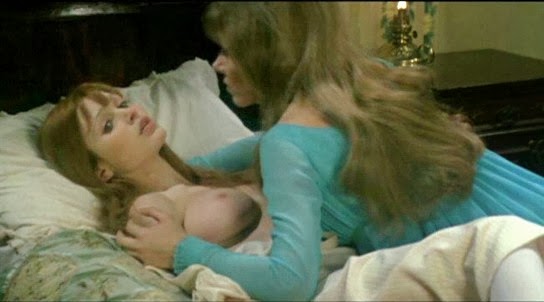
Throughout the late 1950’s and 60’s Britain’s Hammer Film Productions excelled as purveyors of lurid re-imaginings of the horrors of cinema’s past. From the horror of Christopher Lee’s satanic Count Dracula, the terror of Peter Cushing’s evil Doctor Frankenstein, through to the tragedy of Oliver Reed’s lycanthropy-afflicted Leon Corledo, seeing the words “A Hammer Films Production” guaranteed a lushly realized period setting, sterling performances from a rotating stable of fine British thespians and, most importantly, ounces of blood and heaving bosoms in all of their Technicolor glory. Audiences on both sides of the Atlantic eagerly devoured these ghoulish new takes on classic creature features, but by the end of the 1960’s and the advent of taboo-shattering nightmares presented by such films as ROSEMARY’S BABY and NIGHT OF THE LIVING DEAD, what was once considered shocking had begun to seem stale and passe. At the behest of their co-financiers at American International Pictures, Hammer’s next picture needed to amp up the sex and violence quotient considerably in order to compete in a market quickly becoming saturated with bloodshed. Having experienced their greatest success with HORROR OF DRACULA and its many sequels, the studio decided to tread familiar ground when it produced THE VAMPIRE LOVERS, another adaptation of a  literary vampire tale, this time Sheridan Le Fanu’s novella “Carmilla”. The final product is a moody, sensual, gloriously gothic melding of old school scares and shocking (for the time) modern sexual politics, detailing the reign of terror enacted by a lusty, busty lesbian vampiress in 18th century Germany.


They could have easily retitled this flick THE DEVIL'S BOOB JOB, and it would have been just as effective.

The film opens in classic Hammer fashion, with a questionable matte painting of a castle overlooking a moonlit graveyard, where Baron Hartog (Douglas Wilmer) witnesses an unholy creature draped in a diaphanous gown rise from the mist in search of it’s next victim. When the creature encounters the Baron, it reveals itself as a stunning blonde who instantly transfixes the Baron with her beauty. That is, until her boobs happen to graze the crucifix around his neck, at which point the bombshell vamps out and Hartog violently hacks her head off with his sword. In less than five minutes the film has set the tone for what is to come, delivering boobs, blood, and the promise of blood-covered boobs.


Following this prologue the story then jumps forward an untold number of years, as General von Spieldorf (Cushing) holds a ball at his expansive estate. One of the guests is a Countess who brings along her niece, Marcella (Pitt), a shapely young governess who instantly draws the attention of every male (and female) in attendance. After the Countess receives word that one of her relatives is ill, Spieldorf offers take to care of Marcella while she is away. What Spieldorf doesn’t realize is that this is all a ruse perpetuated by Marcella, who is actually an unholy, undead creature of the night named Carmilla, descended from the evil Karnstein’s, a family of vampires thought to have been killed off centuries before. Soon Carmilla befriends and quickly seduces Spieldorf’s young niece Laura, who grows paler by the day. When Laura finally dies, Carmilla vanishes from the General’s house, only to arrive several days later at the home of Roger Morton (Cole) and his daughter Emma (Smith). Carmilla instantly becomes obsessed with Emma and, in a series of increasingly erotic encounters, consistently persuades the young woman to abandon the phallocentric world of the living and join her in an eternity of naked pillow fights. Will Emma give in to these confusing urges? Can a lesbian vampire in stuffy 18th century Europe really find true love? Will Laura’s grieving suitor Carl finally piece together the identity of Emma’s new friend in time to prevent her from becoming a sweet, sexy daughter of Satan? And are we ever going to get to the slow motion scissoring scene?


THE VAMPIRE LOVERS sounds rather silly on paper, but in practice….actually, it’s still pretty damned silly. The film is full of subtext that is about as subtle as a machete to the face, most glaringly in the scenes in which Carmilla feasts on her sleeping victims. Each of the girls experiences these encounters as a nightmare in which they are smothered by what they say is a giant cat, but which actually looks like a giant bearskin rug. Yes, you read that correct. When the girls are getting their blood sucked by the lesbian vampire (who bites then on the breast, by the way), they imagine themselves being suffocated by an enormous pussy. Apparently in 18th century Germany, carpet munches you!


However, if you are able to ignore some of the more ham-fisted details of the story, you’ll find that there is much to enjoy in this tale, not least of which is the heartbreakingly lustful performance of Ingrid Pitt as the lead villainess. Her Carmilla is a creature of smoldering sexual prowess, able to send the loins of her co-stars soaring with a mere glance. She never comes off as purely evil, but rather a supremely lonely creature in search of a good lay, unable to find acceptance from a society that rejects not only her sexual proclivities, but her very existence. “You must die! Everybody must die!” she declares mournfully to a very confused Emma, while the two watch a funeral procession for one of her victims. Like the best vampires, Carmilla is ultimately a very sad, mulit-layered character, graced with eternal youth, yet eternally aware of the fleeting nature of life. Pitt’s work here saves the film from merely acting as a showcase for full-frontal Victorian nudity.


Speaking of full-frontal Victorian nudity, this flick is chock-full of it! From about the half-hour mark on, Pitt and co-star Madeline Smith take every opportunity to drop their corsets, including a ridiculous(ly awesome!!!) and unnecessary scene in which Carmilla hops out of a bathtub, goads Emma into taking off all of her clothes, and then chases her around the bedroom while light-hearted music frollicks about on the soundtrack. It’s all totally gratuitous and totally in keeping with the exploitation standards of the time, yet never seems particularly sleazy. Considering the deplorable depths other films of the era plumbed for quick thrills, the scenes of lesbianic lovemaking in THE VAMPIRE LOVERS come across fairly tastefully, and to be perfectly honest, are really goddamned hot. As the object of Carmilla’s lust, Madeline Smith perfectly captures the adorable cluelessness and utter helplessness of Emma, and the supporting cast is made up of various Hammer veterans, most notably Cushing and John Forbes-Robertson. Cushing is sorely missed during the film’s midsection, but returns just in time to deliver one of it’s best lines in the final scene, while Robertson is eerily effective in the small role of Carmilla’s guardian, a salacious vampire horseman who watches the entire proceedings from afar.


Roy Ward Baker, a veteran of numerous Hammer productions, delivers the usual goods from a directorial standpoint. The film is dripping with gothic imagery of ghoulish graveyards and several stylish shots, including a rather neat zoom out through a key hole. The best directed scene in the film is without a doubt when Carmilla, framed entirely in silhouette, undresses and seduces Emma’s governess, Mademoiselle Perrodot (O’Mara). Through careful composition and lighting Baker is able to effectively disturb and titillate his audience. The only real complaints I can lob at the film is the total disappearance and lack of explanation of the Countess character and, despite the presence of a strong-willed female villainess, it’s reinforcement of the notion that the staunchly male establishment is the only cure-all for tawdry, ungodly lesbianism. And so the film culminates in a scene in which the stern male authority figures exert their dominance by penetrating Carmilla’s bosom with a large wooden stake. The symbolism is about as subtle as, well, a blunt wooden shaft piercing a titty.

But if you can look past the filmmaker’s very on-the-nose approach to the sexual politics on display, what you will find is a well-produced little low-budget gem, brimming with atmospheric direction, passionate performances and searing sexual tension. THE VAMPIRE LOVERS is a very fun, highly erotic twist on a familiar story that refuses to die. In fact, I was so enamored by this tawdry tale that I’ve already begun working on the screenplay for my unofficial sequel. I’m calling it, THE SCISSORING SUCCUBI.

My Rating:
7.5/10


Ahem! And, um.....these lovely ladies all get 10's.


Tuesday, October 1, 2013

October 2013 Edition #1: ZOMBIE HOLOCAUST


Director: Marino Girolami
Screenplay: Fabrizio de Angelis; Romano Scandariato
Starring: Ian McCulloch; Alexandra Della Colli; Sherry Buchanan; Peter O’Neal
Release Date: 1980


Perhaps moreso than any other sub-category in the genre, Italian horror has proven, in my experience, to be more of an acquired taste than most. Garish, uncompromisingly brutal, often featuring tackily mismatched soundtracks, and always poorly dubbed, Italian horror films constantly tread the fine line between Ed Wood-level incompetence and sheer exploitative brilliance. The plots are threadbare, the special effects range from stomach-churningly realistic to ridiculously rubbery, the directors always have names like Mario, Dario, or Lucio, and the visuals are often unsettling and nightmarish. Whether the film in question features the artistic bravado of Argento and Fulci, or the sub-incompetent sleaziness of Bruno Mattei, I am always left with the same uneasy feeling in the pit of my stomach, no doubt due to the filmmakers’ willingness to plumb depths of depravity that few mainstream films dare.


Marino Girolami’s ZOMBIE HOLOCAUST falls somewhere in the middle of the “Argento to Mattei” scale, neither particularly well-crafted or technically proficient, yet not at all worthy of the much deserved scorn of such dreck as Mattei’s HELL OF THE LIVING DEAD. The film was the brainchild of Fabrizio de Angelis who, after the massive success he experienced producing Fulci’s ZOMBI 2 (which itself borrowed heavily from George Romero‘s zombie mythos), concocted a storyline that melded the two most popular Italian horror genres, zombies and cannibals, thus allowing him to completely recycle not only most of ZOMBI 2’s screenplay, but also many of the same actors and various locations. The film is admirable in it’s shamelessness, featuring gratuitous scenes of faces being forcibly introduced to outboard motors, impromptu heart removals, scalpings, defenestration, eye-gougings, and the repeated senseless undressing of it’s lead actress. ZOMBIE HOLOCAUST is Italian horror filmmaking in it’s purest, primal, most penny-pinching form, featuring such a jaw-dropping streak of mean-spiritidness and spite for it’s audience that I spent much of the film’s running time shaking my head and laughing at the filmmaker’s low-brow attempts to shock and disturb.


The film follows the same basic structure as ZOMBI 2, with that film’s lead actor Ian McCulloch portraying Dr. Peter Chandler, who uncovers what appears to be a cannibalistic cult operating in New York City after various limbs turn up missing from the corpses at several local morgues. He enlists the aide of busty (and often nude) morgue assistant/anthropology expert Lori (Delli Colli), who identifies the strange tattoo on a slain cultist’s body as the symbol of Kito, a cannibal god who supposedly reigns over a small island in the East Indies. Along with Peter’s assistant George (O’Neal) and his journalist girlfriend Susan (Buchanan), they set out on an expedition to the mysterious island and are greeted by madness and death at the hands of the cannibalistic natives. The natives follow the orders of Dr. Obrero (Donald O’Brien), a mad butcher who takes great relish in the random dissection and vivisection of his victims, keeping them alive as he removes their scalps and transplants their brains into the corpses of deceased natives, creating an army of docile zombies who do his bidding.


A rare photograph of Thomas Dolby, taken mere moments after he was viciously blinded by "Science".

From that description alone it should be clear that ZOMBIE HOLOCAUST is a film with a massive identity crisis. Girolami and his screenwriters obviously could not decide what type of horror film they were making, and so we are left with an uneven mishmash of zombie and cannibal movie tropes with a dash of mad science thrown in, with very little in the way of narrative cohesion. The early New York segment leaps from scene to scene very suddenly and without explanation, seeming to take place over a period of time that could be a week, or maybe one day, padded out with lots of establishing shots of people pulling up to buildings and entering them. The most jarring example of editorial disarray occurs as our intrepid leads discuss the arrangements of their journey in Peter’s New York office, and then SMASH CUT to B-roll footage from ZOMBI 2 of what is supposed to be their jeep traveling through the jungle. This is lazy filmmaking, clearly intended to get these slabs of meat onto an island, get them naked, and get them dead as quickly as possible.

What saves this mess is the deadpan nature with which the filmmakers approach the gruesome mayhem. In the very first scene a mysterious figure, seen only from the knees down, enters a morgue and proceeds to saw the hand off of an amazingly rubbery and overly lengthy arm for what seems like an eternity. In the next scene the same corpse is used in an anatomy class whose students try to ignore the missing limb, while their teacher attempts to explain the inner-workings of the human stomach by jamming his arm up to the elbow in the gooey innards and rubbing them at the camera in a most unprofessional manner. The entirety of the film lingers on grue for grue’s sake. Some might lob the same argument at the works of Lucio Fulci, but I would argue that his scenes of corporeal carnage and ocular mayhem carry with them a very definite sense of artistry and craftsmanship. Fulci knew how to create incredible tension and unease in his gore set pieces, drawing them out to an unbearable length before punctuating (and puncturing) them with a gloriously moist and brutal punch line, like the ending to some horrible joke.


The makers of ZOMBIE HOLOCAUST carry with them none of this talent. In fact, all they seem to be interested in is saying, “Hey, look at this fucked up shit! LOOK AT IT!!”. Which is fine on it’s own, I suppose, and I won’t deny experiencing a certain adrenaline rush during certain gory segments, the outboard motor to the face scene being a shining example. Dr. Obrero is played so ham-fistedly evil that he skips right past being menacing and winds up seeming like a thirty-years-too-early parody of the torture porn genre. I mean, he ties a girl up, removes her scalp, and keeps her alive during the entire process so he can tell her that he is transplanting her brain into the body of a rotting male native, right before he forces her jaw open and snips her vocal cords with a pair of scissors to silence her screams. That’s so fucking mean that it’s stupid, and O’Brien’s performance does nothing to convince me that the whole thing wasn’t meant to be played for laughs. It should be noted that the film was initially released in the States under the title DR. BUTCHER, M.D.(MEDICAL DEVIATE), which should give you a good idea of the tone it's distributor was aiming for.


Clearly this NEEDED to happen.

The entire sordid affair culminates in a jaw-dropping climax in which the absolutely gorgeous Delli Colli is captured by the natives, stripped of all her clothing, adorned head to toe in sacrificial paint, and made to lie spread-eagled on a giant stone slab that just happens to feature a concavity that her body fits perfectly into, all while several dozen natives stand around her chanting madly. Through some bizarre, unexplained telekinesis she is able to invoke the power of Kito and send the natives, who now worship her as a goddess, on a bloodthirsty rampage against Dr. Obrero and his minions. You’ve certainly got to respect the balls it must have taken for the actress to go through with this scene, especially for such  sleazy grindhouse fare. You would certainly never see Jennifer Lawrence put herself in such a situation for her art, that’s for goddamned sure! (Though we can always hope)


Cheap, filthy, uncomfortably racist, and just all-around cynical, ZOMBIE HOLOCAUST is typical of the exploitation fare that was coming out of Italy in the early 80’s but, in terms of pure entertainment, is certainly one of the better examples of the genre. The plot sorta makes sense as long as you don’t think about it at all, the special effects aren’t entirely terrible, and not five minutes goes by without either a titty, or some horrendously offensive atrocity being committed against a piece of rubber. It might have had something to do with the beer I’d been drinking, but as the end credits rolled over the same burning church from the ending of ZOMBI 2, I distinctly experienced what must have been the death of several brain cells as I tried to process what I had just witnessed. The feeling was oddly cathartic, so in a way I guess ZOMBIE HOLOCAUST is the cinematic equivalent of a cheap high, like huffing a can of air duster. Sure, it’s fun for a little while, but if you’re not careful, you might just wind up brain dead.

My Rating:
6/10